

Patio screen fabrics should be chosen by the problem you need to solve: insects, sun exposure, privacy, or a combination. Compare the actual mesh, openness, appearance, and system compatibility rather than relying on a category name. Check samples from the seating area and the opposite side, including the evening lighting you expect to use.
At a glance
- Insect, solar, and privacy describe goals that may overlap, not interchangeable specifications.
- Openness is a fabric characteristic, not a guaranteed cooling or privacy percentage.
- The full screen includes edges, guides, a housing, and an operating arrangement.
- Daytime sample appearance does not establish nighttime privacy.
- Different openings may need different priorities or fabric choices.
Start with the problem at each opening
Choose a screen fabric around a specific opening and a specific need. A pool-facing side may prioritize visibility; a side facing a neighbor may prioritize privacy; another side may receive the sunlight that makes a particular chair uncomfortable.
StruXure Georgia distinguishes insect, solar, and privacy objectives in its screen offering. Treat those categories as the start of a selection discussion and confirm the currently supported fabrics for the proposed system.
Do not ask one broad label to answer every question. A fabric described as “solar” still needs a defined openness, color, product identity, and suitability for the intended screen. A fabric described as “privacy” still needs to be evaluated under the lighting and viewing conditions that matter to you.
Write the priority for each side before reviewing samples. That simple step makes it easier to recognize a tradeoff instead of interpreting every sample as a promise to deliver maximum visibility, maximum privacy, and maximum openness simultaneously.
Compare patio screen fabrics by purpose
The following table is a selection framework. It does not establish a performance specification for every fabric in a category.
| Primary objective | What to examine | What not to assume |
|---|---|---|
| Insect screening | Mesh identification, system edges, bottom closure, and access points | A fabric sample alone proves insects cannot enter anywhere |
| Solar control | Published fabric properties, openness, color, and the exposed opening | A product percentage equals the same reduction in patio temperature |
| Privacy | Views from both sides under relevant lighting conditions | A daytime view test guarantees privacy after dark |
| A view toward the garden | Actual sample at normal viewing distance and eye level | The smallest sample in a showroom represents a full lowered screen |
| Multiple needs | The documented combination of fabric and complete system | Every solar fabric is an equally suitable insect or privacy solution |
Phifer’s exterior sun-control range includes products intended for screening and exterior shading applications. The precise attributes still belong to the individual fabric rather than the whole category.
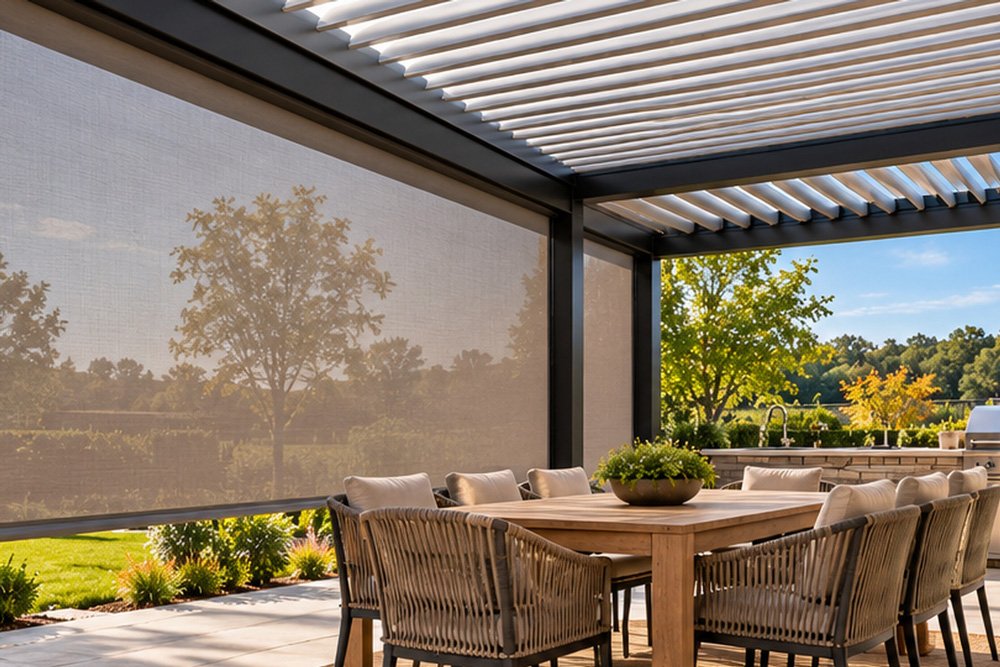
What does openness factor mean?
Openness factor describes the open area of a fabric’s weave. It is useful for comparing specified fabrics, but it should not be read as a direct percentage of temperature reduction, privacy, airflow, or protection across an entire outdoor space.
For a documented manufacturer example, Phifer lists SunTex 95, SunTex 97, and SunTex 99 with approximate openness values of 5%, 3%, and 1%, respectively. These examples illustrate how a supplier names and quantifies different fabrics; they are not confirmation that StruXure Georgia offers those exact products. 3
| Manufacturer example | Published approximate openness | Appropriate use of the number |
|---|---|---|
| Phifer SunTex 95 | 5% | Compare the identified fabric with another specified sample |
| Phifer SunTex 97 | 3% | Discuss the tradeoff with visibility and the intended application |
| Phifer SunTex 99 | 1% | Evaluate the actual sample rather than assuming complete privacy |
Ask the installer to identify the selected fabric by manufacturer and product code. “One-percent screen” is not a complete specification when color, construction, dimensions, or system compatibility remain undefined.
Selection insight: A small difference between printed percentages can distract from a larger practical difference in your view or lighting. Use the number to organize the comparison, then inspect the material in context.
Can one fabric solve insects and sunlight?
A fabric may serve more than one purpose, but the combined performance needs confirmation for the actual product and screen assembly. Do not assume a solar-control label automatically establishes the insect-screening result you expect.
Discuss which insects are the concern, the selected mesh, and how the complete system closes at its sides and bottom. A fabric panel is only one part of the opening. Doors, adjacent gaps, transitions, and normal entry and exit also affect the experience of the space.
Keep the expectation honest. Screening an open-sided patio is not the same thing as creating a sealed room. Ask the provider to explain limitations clearly rather than relying on “bug-free” wording that does not identify the conditions.
For a patio used mainly for evening meals, insect screening may be the leading objective. For a particular west-facing opening used in the afternoon, solar control may deserve more weight. Evaluate the combined option against those actual uses instead of choosing the densest-looking sample by default.
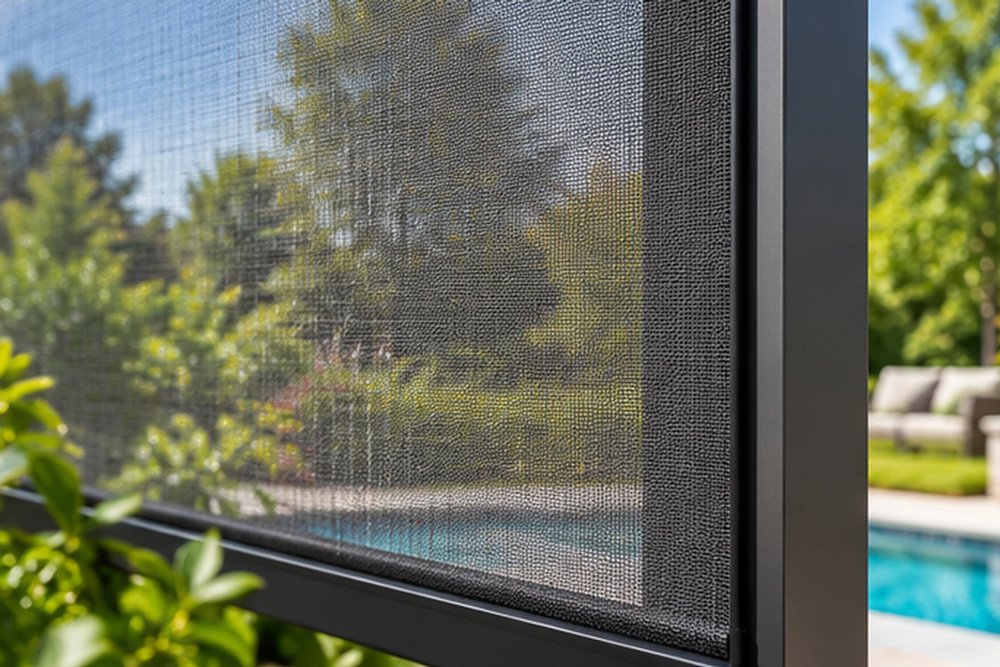
How should privacy be tested after dark?
Privacy should be tested under the lighting conditions in which you expect to use the patio. Do not infer an evening result from a daytime sample viewed only from the shaded side.
As a practical evaluation method, observe the sample from the seating position and from the opposite side. Repeat with the patio lighting on at the level you intend to use. Record the viewing distance and which side is brighter so the result can be discussed accurately.
This is a proposed homeowner sample test, not a laboratory rating or a report of testing already performed. A provider may be able to arrange a more representative demonstration with a larger sample or installed example; confirm what is available.
Treat “privacy” as a set of questions. Can a person be recognized? Can activity be seen? Is the goal to soften a view or to prevent a clear view into the space? Different expectations can produce different material choices even when the same product is being considered.
Selection insight: A privacy decision is incomplete until the direction of viewing and lighting conditions are stated. The word alone is too broad to act as a specification.
Evaluate color and view in the actual setting
Fabric color should be reviewed with the house, frame finish, and view beyond the opening. Ask to see the proposed color, not just another sample from the same product family.
Hold the sample at the intended viewing height and compare it from a normal seating distance. A fabric seen close to your face can feel different from a full screen several feet away, so discuss how representative the sample is before making a final decision.
Assess the visible housing and guides as well. A carefully chosen fabric can still feel visually disconnected if the surrounding hardware was not included in the finish review.
Do not assign a universal winner to dark or light fabrics without considering the actual product and goal. The useful question is which sample produces the view and appearance you prefer while meeting the verified application requirements.
Fabric specifications are not system specifications
A motorized screen combines fabric with a housing, guides, bottom bar, motor, and mounting arrangement. The allowable opening and operating instructions belong to the selected complete system, not to the fabric alone.
Phantom’s motorized-screen information illustrates why the assembly matters: it describes both surface-mounted and recessed integration options. Those are examples from a screen manufacturer, not a claim that Phantom is the locally supplied brand for your project. 4
Ask the proposing installer to confirm the fabric-and-system combination, opening dimensions, exposure suitability, and operating limitations. A product that is suitable in one assembly is not automatically approved in another.
Do not transfer a wind limit from a fabric brochure, another manufacturer’s screen, or a neighboring installation. Weather operation needs the actual system instructions and the site-specific handover.
Maintenance also needs separate attention. A finish cleaner approved for the pergola frame is not automatically approved for the screen mesh or guides. Keep the care documents for each component available.
Different sides can have different priorities
A patio does not need to be treated as one uniform exposure. Consider whether each opening has the same use, view, and privacy requirements before specifying a repeated fabric around the perimeter.
An illustrative layout might keep the garden-facing view as open as practical while prioritizing privacy toward a neighboring terrace. Another might place stronger solar-control emphasis on one exposed side while focusing on insect screening elsewhere.
Those are design concepts, not performance claims about a specific fabric combination. The selected screen manufacturer and installer must confirm whether different fabrics are suitable within the proposed arrangement.
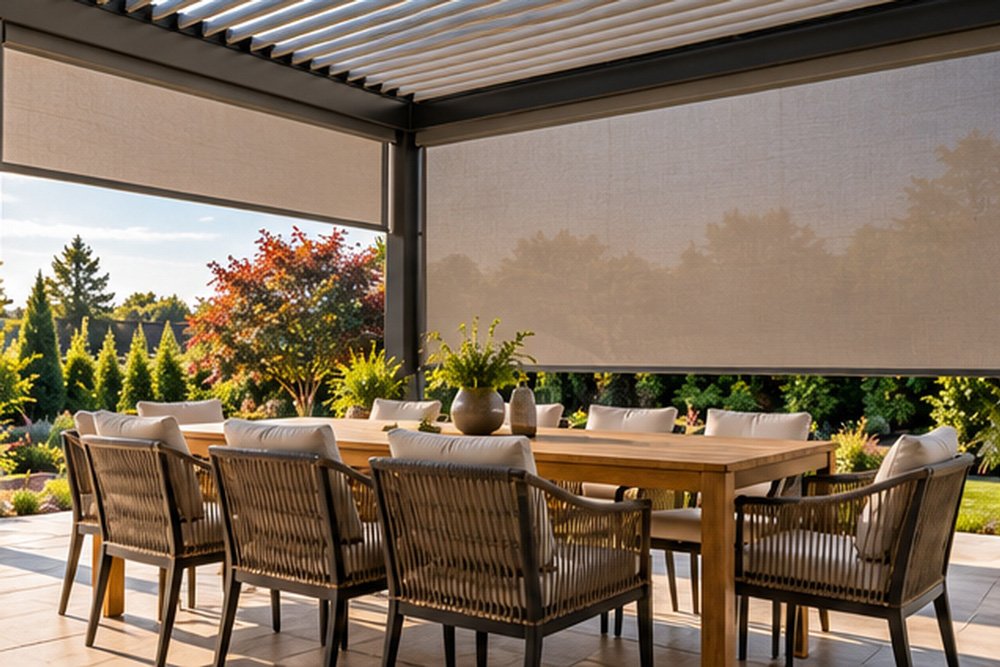
Ask how the appearance will read when some screens are raised and others lowered. A coordinated result can include different functional choices, but the variation should feel deliberate rather than accidental.
A sample-selection process you can use
- Identify the opening. Record its position, view, exposure, and main use.
- Rank the objectives. Put insects, sunlight, privacy, and visibility in your own order of importance.
- Request identified samples. Record manufacturer, product code, color, and documented properties.
- Compare in context. View each sample from both sides and under relevant daytime and evening conditions.
- Confirm the complete system. Verify dimensions, compatibility, edges, operation, and care with the installer.
- Record the approved selection. Keep the fabric and hardware finish schedule with the project documents.
At the end of the process, the chosen sample should have a reason attached to it. “We selected this fabric for the neighbor-facing opening after reviewing the evening view” is a more useful decision record than “We chose the best screen.”
Common selection mistakes to avoid
The first mistake is buying a percentage instead of a result. Openness and other published properties are useful, but they do not replace a discussion about the whole opening and intended use.
The second is comparing unidentified samples. Two swatches with similar appearance may have different product specifications or approved applications. Keep the product identities visible throughout the review.
The third is treating screening as a structural or safety barrier. An ordinary insect or solar screen should not be assumed to function as a required guard or pool barrier. Have those requirements reviewed separately.
The fourth is leaving the sample decision until after the system has been specified without checking compatibility. Resolve the material selection early enough that the actual product can be included in the reviewed proposal.
Frequently asked questions
Does one-percent openness mean complete privacy?
No. Treat the openness figure as a fabric property, not a complete privacy guarantee. Evaluate the identified fabric from both sides under relevant lighting and viewing conditions. Discuss whether your goal is reduced visibility, a softened view, or stronger privacy, because those expectations are not identical.
Can I match a screen fabric to my pergola frame?
You can evaluate coordinated colors, but fabric and coated metal are different surfaces. Review actual samples together and include the housing, guides, and bottom bar in the finish schedule. Do not assume a shared color name means the materials will look identical in changing light.
Should I choose the same fabric a neighbor uses?
Use the neighbor’s installation as a discussion point, not a specification. Your opening size, exposure, seating position, lighting, and screen system may differ. Ask for the exact product identity and evaluate it against your own requirements before assuming the result will be the same.
Can screen fabric be changed in the future?
Ask the installer about the specific system’s replacement process, compatible fabrics, service requirements, and cost factors. Do not assume that any fabric can be substituted into the existing hardware. Keep the original product information so future discussions begin with the actual installed assembly.
Patio screen fabrics work best when the selection connects a documented product to a clearly defined need. Explore screens and shade systems with that comparison in mind. StruXure Georgia serves Metro Atlanta and North Georgia. Request a Design Consultation to discuss the openings and priorities for your home.